

 Product Category
 ZenMarketについて
 海外配送
海外配送 Campaign Information
 official app
 0120-354-038




2025.05.08 column
What happens if you keep eating Manuka honey? What effects can you expect?

Have you ever seen the word "Manuka honey" on the products sold at supermarkets and convenience stores?
Some of you may be wondering, "I see it often, but how is it different from other honey?"
In this article, we will explain the differences between Manuka honey and other honeys, as well as the changes that occur in the body when you continue to eat it.
Please read to the end and use this information to help you achieve a healthy diet.
First of all, what is Manuka honey?
Manuka honey is made from the nectar of the flowers of the Manuka tree, which grows in only a few areas of New Zealand.
Manuka honey, made from the nectar of rare trees, is strictly controlled in quality and price by the New Zealand government.
Only honey that passes these strict government inspections is allowed to be called "Manuka honey" and distributed on the market.
What makes it different from other honeys?
Manuka honey contains a compound called methylglyoxal that is not found in other honeys.
Methylglyoxal, when consumed regularly, helps build a strong body.
In addition to the inherent strengths of honey, Manuka honey contains a unique compound called methylglyoxal, which helps support a healthy lifestyle.
What happens if you keep eating Manuka honey?
Now let's explain what happens if you keep eating Manuka honey.
However, please note that what is described below may vary from person to person and we do not guarantee any specific effects.
Build a strong body
Manuka honey has traditionally been used by the indigenous Maori people of New Zealand to treat wounds and throat and stomach problems. It contains the unique antibacterial component methylglyoxal, and is still attracting attention today as a natural antibacterial agent for wound treatment and oral care.
By regularly consuming Manuka honey, the effects of methylglyoxal will bring out the body's natural health and support a strong body that is less susceptible to illness.
Feel refreshed from the inside of your body
Manuka honey helps to purify the body from the inside out, helping you feel refreshed and in good health every day.
If you're worried about not feeling refreshed, try incorporating Manuka honey into your regular diet.
You can maintain your beauty
If you can maintain your beauty, your friends and people around you may start asking you, "Do you do any special skin care?"
To keep your skin firm and firm every day, why not try eating Manuka honey in addition to your daily moisturizing care?
Related articles:What is Manuka honey? A detailed introduction to its effects and recommended ways to eat it
Concerns about continuing to eat Manuka honey

There are some concerns to keep in mind when enjoying healthy Manuka honey every day.
Be aware of these two concerns before incorporating Manuka honey into your daily routine.
Concern point 1: The calories are somewhat high.
Manuka honey tends to be a little high in calories.
The calorie content of Manuka honey is about 300 kcal per 100g, which is slightly higher than the 294 kcal of regular honey. Therefore, if you continue to eat it without paying attention to the quantity, you may unknowingly exceed your calorie intake and gain weight.
For those who are mindful of health and beauty, it is advisable to consume about 1 tablespoon per day, divided into 2 to 3 doses.
As long as you keep a close eye on your intake, you can enjoy Manuka honey without worrying about sudden weight gain.
Concern point 2: Unique flavor
Manuka honey has a unique flavor, which may lead some people to feel that they "do not particularly like the taste."
For those people, we will introduce ways to eat it that will soften the flavor later, so please feel free to use this as a reference.
Related articles:Explaining the conditions for those who should not eat Manuka honey and the reasons why
How long will it take for you to see expected changes from Manuka honey?
Although this varies depending on individual physical condition and the amount consumed, it is generally said that it takes about 1 to 3 months for the expected changes from Manuka honey to appear.
Remember that it takes time to build a strong body.
Even if you don't notice any immediate changes, the most important thing is to continue eating it.
When to eat Manuka honey
It is recommended to have Manuka honey before breakfast and before going to bed.
Please see the table below for a summary of the expected effects and possible concerns depending on when you eat it.
Expected effects and concerns based on different eating timings.
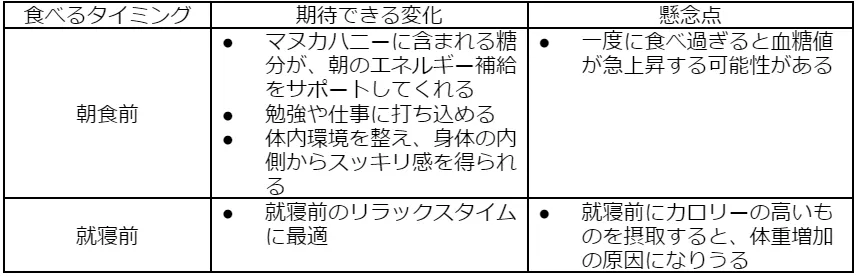
When consuming Manuka honey, be sure to keep the above concerns in mind and observe the recommended intake amounts.
Things to remember when taking Manuka honey

After reading this far, some of you may be wondering, "Should I try Manuka honey?"
For those people, below we will explain the points you should remember when continuing to eat Manuka honey.
Point 1: Adhere to the intake amount.
When consuming Manuka honey, be sure to consume in moderation.
While this varies depending on your individual health condition, the recommended dosage is about one tablespoon per day.
Although Manuka honey contains a variety of nutrients, the amount consumed does not necessarily correspond to the expected effects.
The more you eat, the more calories you will take in, so it is important to keep your eating within the set amount per day.
Related articles:Does eating honey make you gain weight? Here are some tips on eating it
Who should take Manuka honey?
Based on the information above, we have reorganized the characteristics of people for whom Manuka honey intake is recommended.
▼Characteristics of people who are recommended to take Manuka honey
- ・I want to have a strong body
- ・People who want firm skin
- ・I want to improve my internal environment
- - Exercising
If any of the above applies to you, you should consider incorporating Manuka honey into your daily diet.
Delicious ways to eat Manuka honey
If the above applies to you, or if you're thinking about trying Manuka honey for your health, then be sure to check out the delicious ways to eat Manuka honey introduced below.
We will also introduce ways to reduce the unique flavor.
Eat as is
If you don't mind the unique flavor of Manuka honey, it's delicious just as is.
With just one spoon, you can easily consume the various nutrients contained in Manuka honey.
Sprinkle on toast or yogurt
We also recommend putting it on toast or yogurt, as it's easy and delicious.
If you are putting it on toast, make sure to butter it first.
The richness of the butter combined with Manuka honey makes it even more delicious.
Also, eating it with yogurt will soften the unique flavor of Manuka honey, so if you don't like the unique taste, try this method.
Use instead of sugar
You can also add Manuka honey to your coffee or tea as a sugar substitute.
In particular, the bitterness of coffee goes well with the sweetness of Manuka honey, and the unique flavor of Manuka honey is also softened, making it even more delicious.
However, some of the nutrients in Manuka honey are destroyed by heat.
Therefore, it is a good idea to let it cool a little before dissolving it until it reaches a drinkable temperature.
Related articles:Introducing how to eat Manuka honey for its amazing health benefits
By continuing to eat Manuka honey, you can expect to build a stronger body!

This time, we explained what happens if you keep eating Manuka honey.
By continuing to consume Manuka honey, you will increase the chances of feeling healthy every day.
However, eating too much can lead to weight gain, so it's important to keep an eye on your intake and use it to help maintain your health.
Column Supervisor
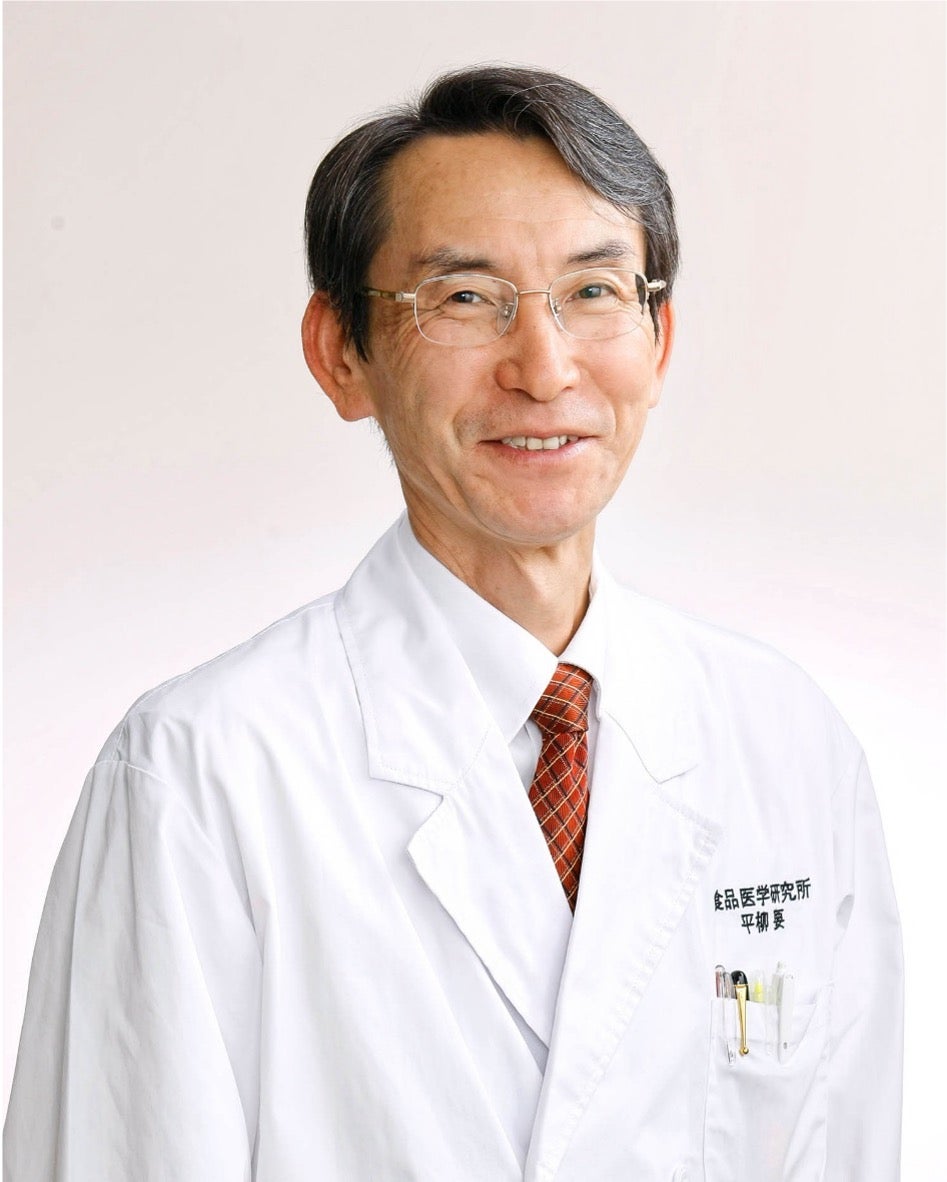
Hirayanagi Essential Mr.
Title: Doctor of Medicine (University of Tokyo) / Master of Health Science (University of Tokyo)
Affiliation: Food Medical Research Institute, Representative and Director
Brief Biography
After completing the graduate program in Physiology at the University of Tokyo, they became a visiting researcher at the University of Parma in Italy, Harvard University, and the Massachusetts Institute of Technology, and then became an associate professor in Hygiene at Nihon University School of Medicine.
So far, I have served as a part-time lecturer at Nippon Sport Science University (Public Health / Occupational Health), Sano Nihon University Junior College (Public Health), and held positions as a director in the Japan Ergonomics Society, the Japan Society for Aerospace and Environmental Medicine, and the Japan Society of Clinical Hyperbaric Oxygen and Diving Medicine, as well as a councilor in the Japan Society of Hygiene and the Japan Society for Preventive Medicine Risk Management.
Currently, I am the representative and director of Food Medicine Research Institute.
Specialized field
- Special Environmental Medicine (Space Environment Physiology, Marine Environment Physiology, Occupational Health Science)
- Research on the health effects of food ingredients based on scientific evidence.
[Media appearances]
NHK 'Try It and Understand'
TBS Television 'The Doctor's The Stamp of Approval!'
TV Asahi 'Hayashi Osamu's Now is the Time! Lecture'
CBC Television "Health Capsule! Time for Vitality"
He has also appeared on many other programs, including MBS, TV Tokyo, and BS Fuji.
Supervision and Contribution Achievements
The Power of Honey (Housewives and Life Publishing Co.)
Magical Honey (Makino Publishing)
A special ginger recipe for body alignment (Natsume Publishing)
In addition, I have been featured in magazines, newspapers, and magazines about the health benefits of food.
He has contributed and supervised over 200 articles.
[Works]
The surprising effectiveness of sunbathing in cancer prevention - the astonishing power of vitamin D (Kodansha)
"Don't Get Sick! Ginger Green Tea Health Method (Published by Sanmark, Chinese version available)"
A longevity furikake created by a medical doctor (Sanmark Publishing)
Other specialized books include "Modern Life and Health" (Shinohara Publishing) and "New Edition of Hygiene Practice" (Nanzando), among others.
He has written many books on health and wellness.
[External link]
Food Medicine Research Institute Blog: http://h-and-w.jp/column/
My Best Pro Gunma Blog: https://mbp-japan.com/gunma/food-medicine/column/